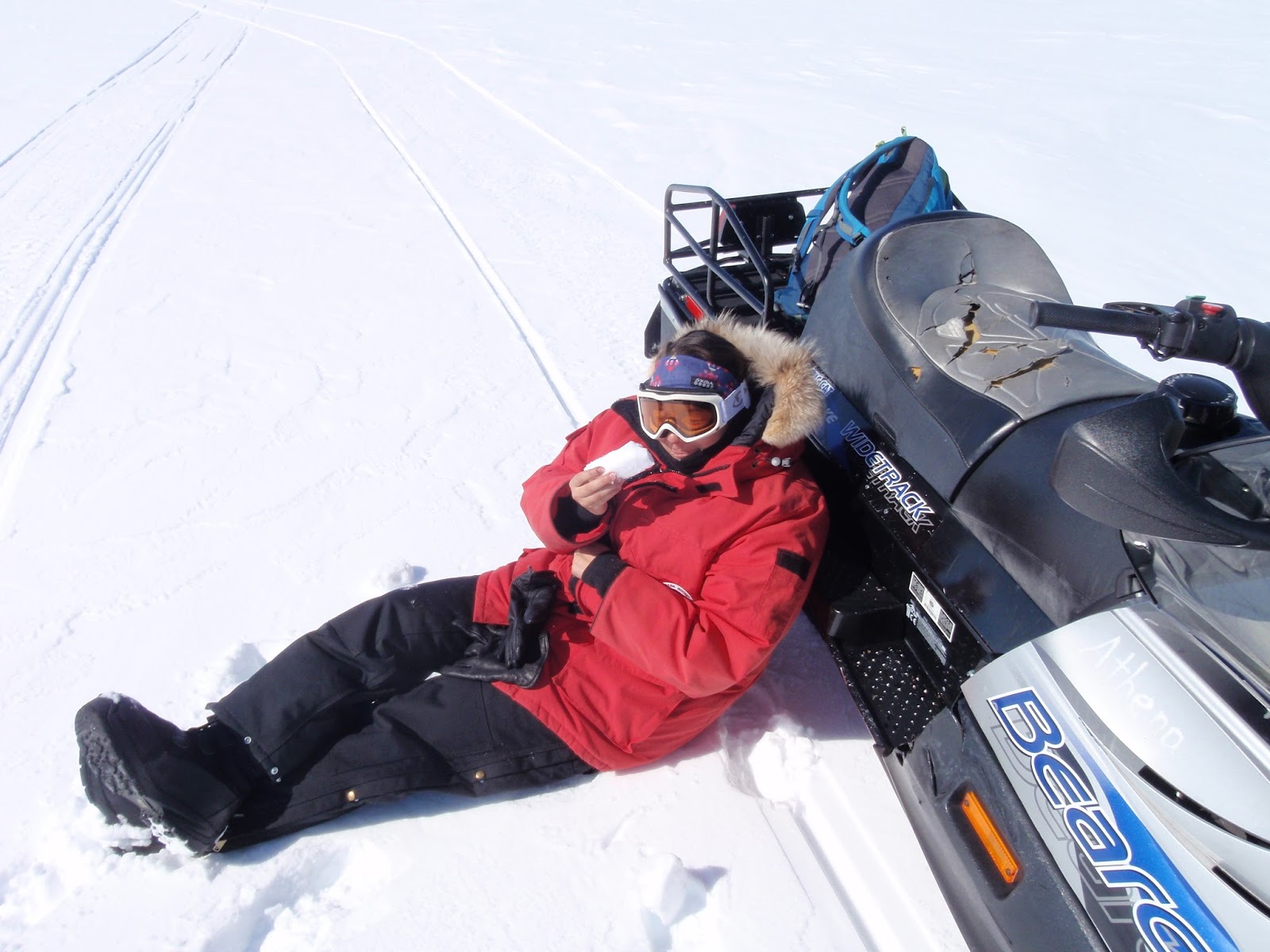
Monday, June 27, 2011

Time to go back for another project!


I'm back once again in Greenland- in Kangerlussuaq. We arrived this evening and are now safely set up in the Kangerlussuaq International Science Support building.

This season will be a first for me on many fronts- for starters, not going to Summit! In this project, we plan to drill to the bed of the ice sheet near the margin, to investigate the subglacial hydrological system. So we'll be in the margin of the ice sheet (a first for me), at "warm" temperatures, so we will experience a melting surface (sounds like it's slushy up there right now)- another first.

I'll also be working with 6 people with whom I haven't worked in the field before- another first, and to top it all off, although I know a lot about the equipment we are using and the measurements we'll be making, I have never used any of it in the field! ok, then!

Here's a shot from my testing of my new borehole "bed camera". I was taking a photo every minute automatically, and wanted to be taking a picture of something that would always be changing, so I decided to use a clock!

Ok, all for now- tomorrow we fly to Ilullisat, and thence to the ice! I may or may not be able to post from the field, as we will be on a sat-phone data link. Stand by!

Tuesday, June 22, 2010

Packing up, hopefully flying out!


Today was a day of packing boxes, getting things ready to be shipped back to Dartmouth. By the middle of the day, we'd gotten our gear all packed and "palletized" which means that it's strapped down to an aluminum Air Force pallet, the basic unit of cargo on the LC-130 aircraft on which we fly. Above, our cargo sits ready on its pallet, waiting for the plane! Once this was done, our team joined the GA pool. GA is short for General Assistant, which means doing odd jobs around camp to help out. Our task was to re-set some flags marking hazardous areas around camp. Job almost complete, we'll work on it more tomorrow while waiting for a plane!

Monday, June 21, 2010

FInal pit of this trip


Weather today was beautiful, and we started early to help Gifford with his last melt experiment pit of the season. In addition, it was Gifford's turn to "house mouse" (see my post from 2006 about this duty), so I worked on many of his chores while he worked the pit, since this is really his experiment. Above, Gifford cleans the pit wall to prepare for visible and NIR photographs to view stratigraphy.

Sunday, June 20, 2010

Stormy day

No pits of today, as it was really too stormy to do much work outside. But we could still look at our data, and repackage our ice cores, which we did. Long day spent mostly indoors.

Saturday, June 19, 2010

More pits!


Today we dug another pit at a location we call ICESat-Center. This particular pit is the last in a series of pits that Zoe dug while on the traverse from NEEM to Summit. Above, Zoe teaches Gifford the finer points of recording physical stratigraphy in the pit.

Friday, June 18, 2010

More GPS surveying


Today the winds were pretty high, so it would have been difficult to dig a pit (it would fill in almost as fast as you could dig it out). I spent much of the day working with the science techs, going over the protocol for the GPS surveying they do each month (I posted about this surveying a while ago here). Before we went out, I placed a standalone GPS station (above) to record a very accurate measure of one spot along the transect. This way we can test out other GPS receiver on the sled- processed kinematically- to see how close it gets to the "real" answer for he surface elevation. Despite the high winds, the whole thing went off beautifully, and I came back with many modifications to make to the sampling protocol, a document that outlines exactly the procedures to take for this experiment.

Thursday, June 17, 2010

Chemistry sampling in the pits


Today was another long one. We performed a melt experiment for Gifford, who wants to look at how chemical signals in the snowpack may be alteredin the presence of melt. The day started out at 5, getting up to be out on our snowmachines (loaded, fueled, with some food in us, ready to go) by 6. Gifford and I went out to our site and applied some "artificial melt", snow that he had collected from this site the night before and melted inside the heated structure. Then, since we needed to give the melt time to percolate and refreeze before we sampled, we came back to camp for breakfast. Following that, we went back out and dug a large pit, took near infrared photographs to record the stratigraphy, and collected snow samples to be analyzed for chemistry- one set where melt had been applied, one set in an unaffected region. Above, Gifford and I sample in tandem. It was a long process- we "broke ground" on the pit at around 10 am, and were filling it back in after we'd finished our work around 5pm. We arrived back in camp after dinner around 7:30, ready for a nice hot meal.